Tick Tips
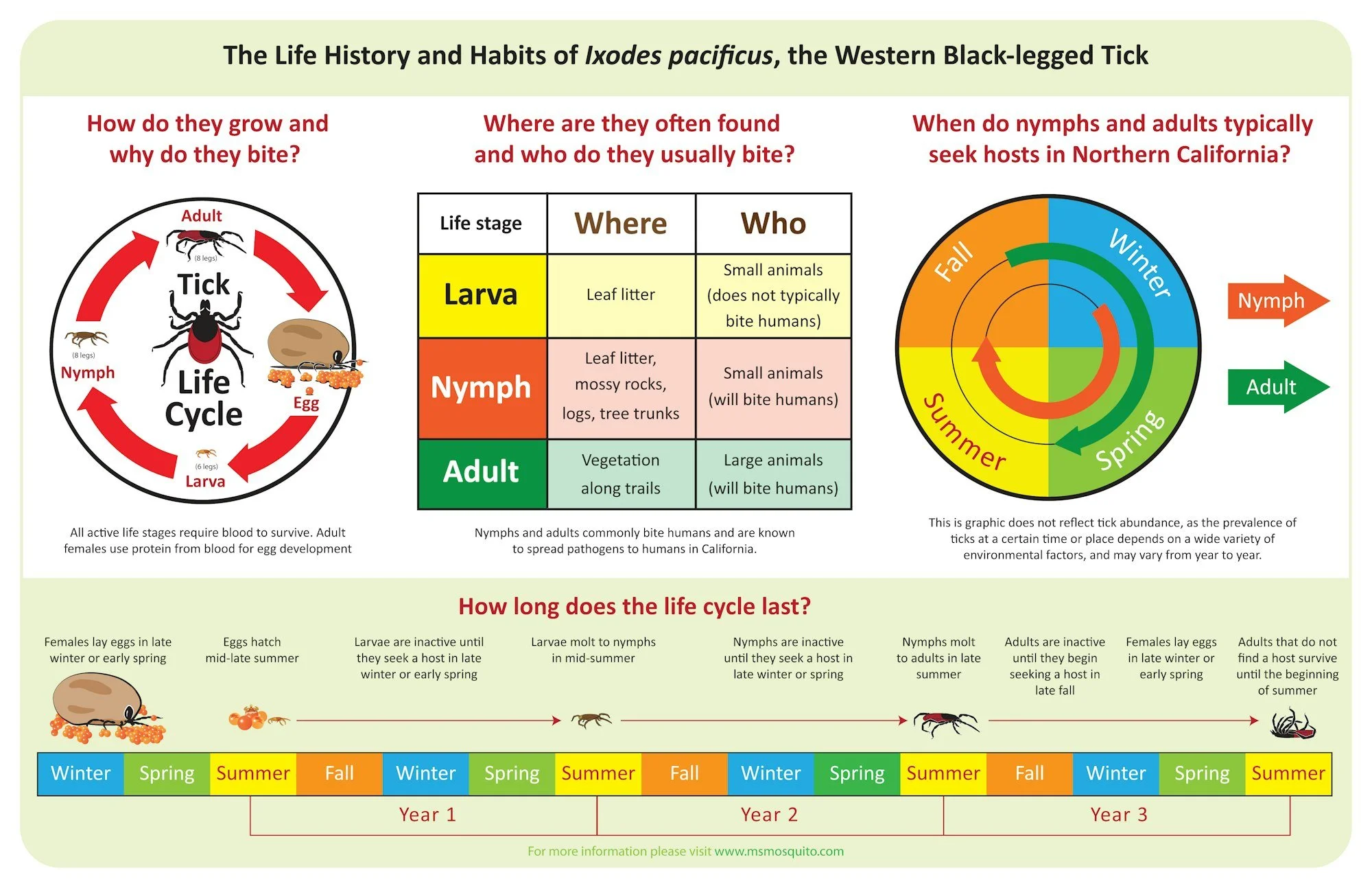
A quick reminder that ticks are active year round. It’s hard to see nymphal ticks which are the size of a poppy seed. Nymphs live on downed trees, leaf litter, mossy rocks. About 4% nymphs are infected with Lyme disease but only 2% of adult ticks. Adult ticks are found in grassy, brushy, or wooded areas, especially alongside trails. Adult ticks wait on the tips of vegetation for a potential host.
To prevent ticks, apply repellent on exposed skin. After hiking, check armpits, hairline, belly button and shower. Put clothes in the dryer for 10 minutes on high to kill ticks.
Helpful tips from the Marin/Sonoma Mosquito & Vector Control District
Western Black-legged Tick Check out the lifecycle and habitat charts
How to remove a tick Tip: Don't crush it in your fingers.
Before entering tick habitat, take the following precautions:
Consider applying a tick repellent to exposed skin that has one of the following EPA-registered active ingredients: DEET, picaridin, IR3535, oil of lemon eucalyptus (OLE), or para-menthane-diol (PMD).
Consider treating clothes/personal outdoor equipment with an acaricide containing permethrin.
Wear light-colored clothing (this makes it easier to spot ticks).
Wear long pants, long sleeves, and long socks whenever possible (this makes it more difficult for the tick to get to your skin).
While in tick habitat:
Stay on trails (adult ticks are typically more abundant on the uphill sides of trails).
Avoid contact with nymph habitat (leaf litter, logs, tree trunks, etc.).
Periodically check for ticks on people and animals.
After exiting tick habitat:
Tumble dry clothes in a dryer on high heat for 10 minutes to kill ticks after you come indoors.
Shower after coming indoors and carefully check for ticks.
Properly remove any attached ticks immediately.